Author: Elham SharifiGhorveh, |Cognitive Health Specialist (Research & Advisory), Estimated reading time: 4-5 min
In our previous article, we discussed how memory functions and why occasional forgetfulness—like forgetting someone’s name or a short-term appointment—tends to happen more as we age, and whether such signs are normal aging or dementia. However, when these signs approach a warning level and we start talking about dementia or Alzheimer’s, distinguishing between different types of memory loss becomes increasingly important. In this article, using clear language and relatable examples, we’ll explore Alzheimer’s vs Dementia vs Normal Aging, focusing on:
- Normal age-related forgetfulness
- Mild Cognitive Impairment (MCI)
- Dementia
- Alzheimer’s Disease
- Dementia vs normal age-related memory loss
Our goal is to clarify these boundaries, critically analyze current knowledge, and highlight
potential future directions and solutions.
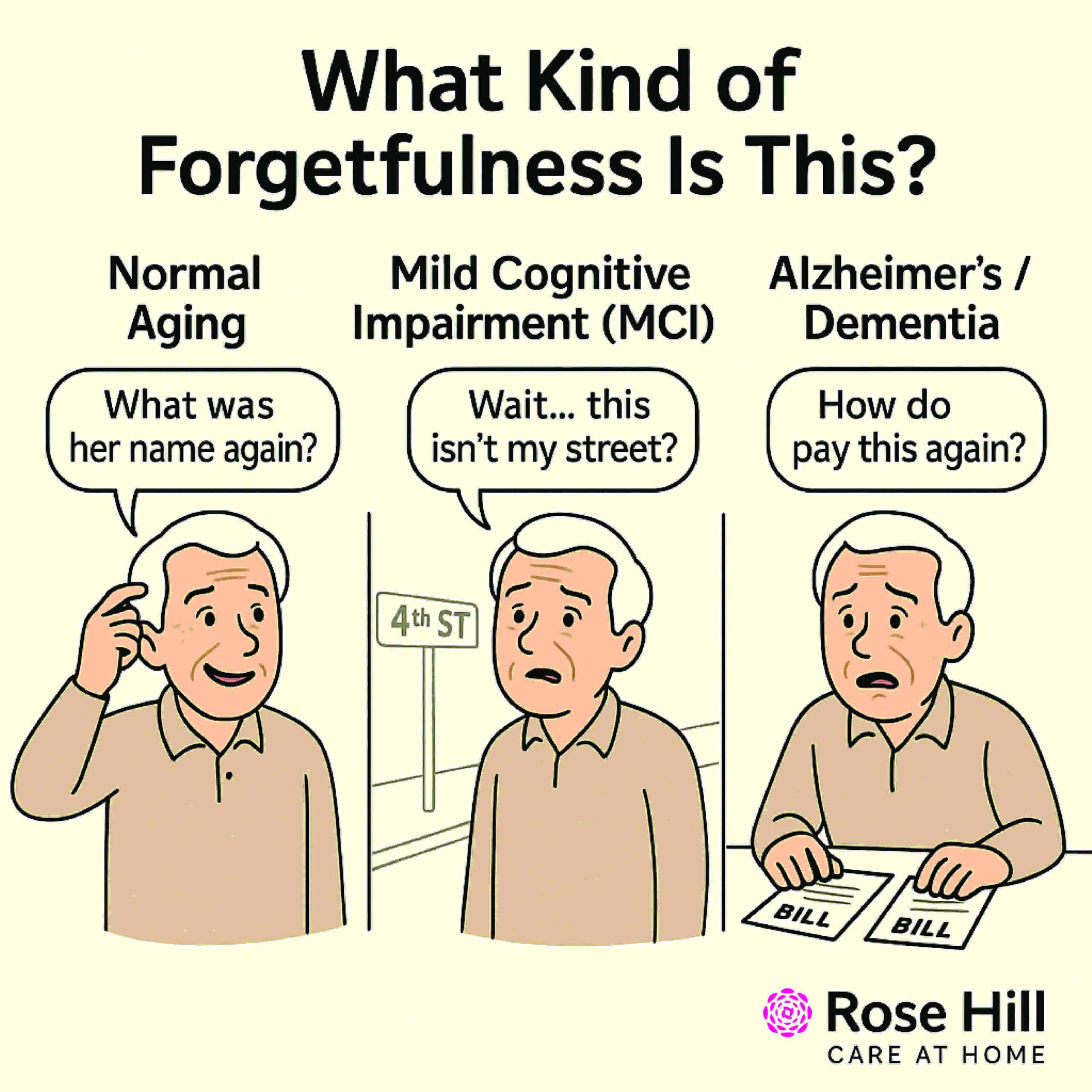
Normal Age-Related Forgetfulness
A simple explanation and example:
When we forget a friend’s name during a gathering or make a small mistake writing a bank account number, these are usually signs of normal age-related memory loss. The brain gradually slows down in processing, and memory becomes slightly sluggish—but these changes are usually mild and manageable.
Key characteristics:
- Mild and scattered: For example, forgetting a familiar name but eventually recalling it on your own.
- No disruption to daily life: Regular activities continue normally.
- Verbal memory is more affected than spatial memory.
Mild Cognitive Impairment (MCI)
MCI is an intermediate stage between normal aging memory and dementia. People with MCI
experience more significant decline in memory or thinking skills than expected for their age, but
they are still able to live independently and carry out daily activities.
About 10–15% of individuals with MCI develop dementia within a year. Some even return to
normal cognitive functioning. Furthermore, about half of people with MCI show biological signs
of Alzheimer’s, such as amyloid and tau accumulation.
Example: Someone who forgets to ring a doorbell or gets lost going to a familiar place but
doesn’t have major complaints about daily life disruption.
Dementia (Major Neurocognitive Disorder)
Dementia refers to a group of disorders involving significant cognitive and memory decline, to the point that independent living becomes impossible. The impairment must span multiple cognitive domains (learning, language, procedural memory, executive function) and interfere with day-to-day functioning.
Example: A person who can no longer calculate part of a bill, follow a simple recipe, or keeps
getting lost at home.
Recognized types include:
Vascular dementia: Caused by stroke or blood vessel issues in the brain
Frontotemporal dementia: Characterized by behavioral or language problems
Lewy body dementia: Includes visual hallucinations
Mixed dementia: A combination of Alzheimer’s and another type, like vascular dementia
Alzheimer’s Disease
Alzheimer’s is the most common form of dementia (accounting for 60–70% of cases), caused by the chronic and progressive accumulation of beta-amyloid and tau proteins in the brain. Understanding the difference between Alzheimer’s and dementia is critical: Alzheimer’s is a specific disease, while dementia is a broader term for cognitive decline.
Disease stages:
- Preclinical stage: Only biomarkers are positive, no symptoms
- MCI due to Alzheimer’s: Mild symptoms begin to appear
- Alzheimer’s-related dementia: Serious impairment to memory, behavior, and independence
Diagnosis now involves imaging with radioactive tracers, cerebrospinal fluid (CSF) tests, or blood tests to detect markers like Aβ and p‑tau. Currently approved medications can slow the disease’s progression. Affordable, non-invasive blood tests for early detection are also in development.
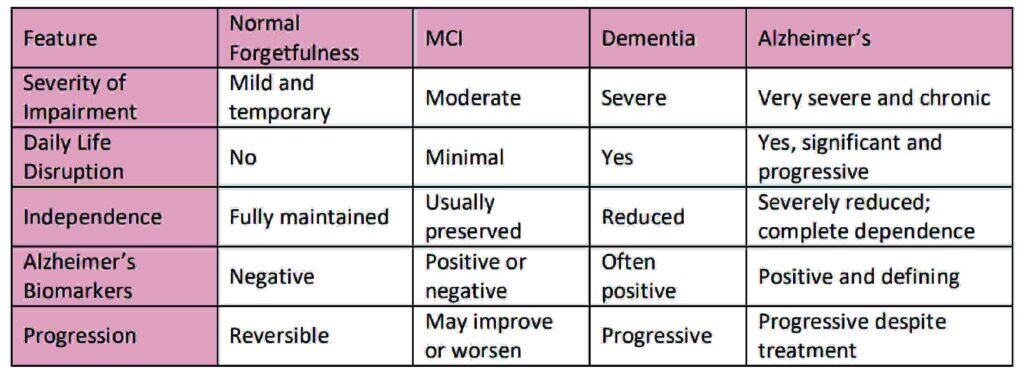
Comparison Table of the Four Phenomena
Key Analytical Takeaways:
Blurred line between MCI and Alzheimer’s: A substantial portion of people with mild cognitive impairment vs normal aging memory will develop dementia within 5–7 years, but some return to normal cognition.
Role of mixed dementia: In people over 85, multiple causes often contribute to impairment;
accurate diagnosis is difficult but essential.
Importance of biomarkers: Advances in imaging and blood tests allow earlier diagnosis, even
before symptoms appear—though they’re still not perfect.
Prevention and lifestyle: Evidence shows that managing blood pressure, staying physically
active, and eating a healthy diet can lower the risk of dementia.
What Can I Do as a Caregiver?
Take early signs seriously. If your loved one:
- Repeatedly asks the same questions
- Gets lost on familiar routes
- Becomes confused about everyday tasks like cooking or paying bills
…it’s time to consult a family doctor or a neurologist to determine is memory loss normal aging or dementia. - Keep a journal to note unusual behavior: For example:
“Today, Mom said twice, ‘Are you going to school?’ even though I’m 42.” - Adapt the home environment:
- Use directional signs (e.g., arrow pointing to the bathroom)
- Set up a daily reminder board in the kitchen
- Install night lights in hallways
- Remove rugs that may cause falls
- Keep communication warm and simple:
- Use short, clear sentences: “It’s lunchtime. Come sit here.”
- Avoid complicated questions. Instead of “Do you remember when we went on that trip?”, say: “That Vancouver trip was lovely, wasn’t it?”
- Use helpful tools:
- Google Calendar with audio alerts
- Talking watches for seniors
- Medical alert bracelets
- Take care of yourself, too:
Caregiving is exhausting. Feeling anger, sadness, or guilt is normal. Make use of available support services in Canada:- Alzheimer Society Canada
- Caregiver Support Programs in your province
- Free phone or in-person counseling
Conclusion
Normal age-related memory loss is part of healthy aging—mild, reversible, and with minimal impact.
Mild cognitive impairment vs normal aging memory is a warning zone but not the end of the road.
Dementia vs normal age-related memory loss involves serious cognitive decline that requires comprehensive care.
Alzheimer’s vs Dementia vs Normal Aging: Alzheimer’s is the most common and severe type of dementia, yet early awareness, smart use of technology, and supportive care focused on physical and mental well-being can make a meaningful difference.
In next week’s article, we’ll explore ‘Factors That Strengthen Memory in Seniors’, and look at lifestyle and habits that help maintain and improve memory in older adults.
MCI is a warning zone but not the end of the road.
Dementia involves serious cognitive decline that requires comprehensive care.
Alzheimer’s is the most common and severe type of dementia, yet early awareness,
smart use of technology, and supportive care focused on physical and mental well-being
can make a meaningful difference.
In next week’s article,
In next week’s article, we’ll explore ‘Factors That Strengthen Memory in Seniors’, and look at
lifestyle and habits that help maintain and improve memory in older adults.
Resources
- Alzheimer’s disease facts & figures (PMC)
- Memory Problems, Forgetfulness, and Aging (NIA)
- Petersen RC et al. Mild cognitive impairment literature
- Healthline: MCI vs dementia vs healthy aging
- NCBI StatPearls: Major Neurocognitive Disorder
- Mayo Clinic: Alzheimer’s stages
- Springer: Quality of life in MCI and mild dementia
- UCLA Med School: Alzheimer vs dementia types
- PubMed Central: Borderland normal aging vs dementia
- Verywell Health: stages cognitive decline
- Verywellmind: Dementia vs Alzheimer’s differences
- Scottish Sun: blood test early Alzheimer
- The Sun: LATE vs Alzheimer identification
- Wikipedia Dementia & AD & MCI pages.
- arXiv: comparative MRI/AI classification studies