Exploring the impact of quality sleep on brain function and cognition.
(Estimated reading time: 5min)
Author: Elham SharifiGhorveh, |Cognitive Health Specialist (Research & Advisory)
Introduction: When Sleep Saves Memory
“Mary, 74, lives in her son’s house in the suburbs of Vancouver. She goes to bed at 10 PM every
night but wakes up repeatedly until 3 AM. In the mornings, she feels disoriented, misplaces her
keys, and doesn’t understand why her memory isn’t working as it used to.”
Is Mary’s forgetfulness solely due to old age? Or is poor-quality sleep silently and gradually
eroding her brain?
This article addresses a vital topic: the role of sleep in the brain health of older adults. We aim to
explore how sleep quality can preserve or damage brain structure, its effect on memory,
concentration, and decision-making, and finally, what solutions exist for improving it.
1- Sleep in Older Adulthood: Why Does Sleep Change with Age?
Older adults often say, “We sleep less because our bodies need less sleep.” However, this is not
accurate.
With increasing age:
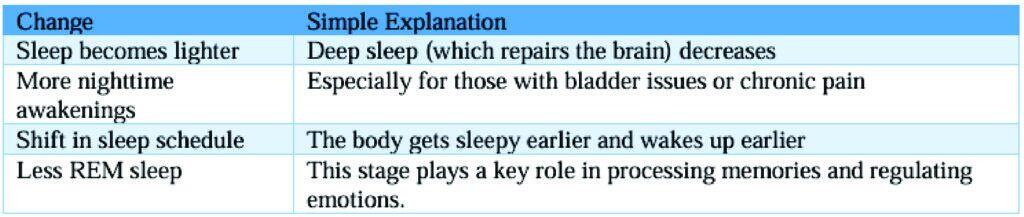
– Real-life example: If an older adult is in bed for 7 hours every night but wakes up 5 times,
their effective sleep reduces to 5 hours or less, just like a mobile phone connected to a charger for
7 hours, but with the power constantly cutting in and out.
How Does Sleep Preserve Brain Structure?
rain imaging studies have shown that sleep quality directly affects the brain structure of older
adults:

During deep sleep, the brain works like a nightly cleanup crew, clearing out waste like amyloid
beta, which is associated with Alzheimer’s.
Sleep and Cognitive Function: Memory, Concentration, Decision-Making
A) How many hours of sleep are best for the brain?
A 2023 study in the UK showed:

Even sleep quality is more important than the number of hours. If a person sleeps for 8 hours but
wakes up multiple times, their brain functions like someone who has slept for 5 hours.
B) Napping: Enemy or Friend?
Short daily naps (20-30 minutes):
✅ Improve working memory and attention
❌ But long naps (more than 45 minutes) increase the risk of obesity, diabetes, and brain decline
Practical solution: For older adults, setting an alarm for short naps can be a simple strategy.
Biological Mechanisms: What Does Sleep Do for the Brain?
Brain cleansing (Glymphatic system): At night, the brain functions like a built-in washing
machine, flushing out toxins during deep sleep. Lack of sleep means these wastes remain, leading
to earlier brain deterioration.
Inflammation modulation: Both too little and too much sleep can raise inflammation levels in the
body. Ongoing inflammation has been linked to shrinkage in key brain areas like the
hippocampus.
Reconstruction of vital brain substances (BDNF): This protein helps grow new brain cells, but it’s
only released during quality sleep. If an individual does not get enough REM sleep, their brain
loses the opportunity for rejuvenation.
Criticisms and Scientific Challenges
Some research shows a relationship between sleep and brain health, but it is still unclear
which is the cause and which is the effect. Does poor sleep cause brain decline? Or does a
diseased brain disrupt sleep?
Results in some studies are contradictory; for example, in overweight individuals, less
than 6 hours of sleep might perform better.
Methods of sleep measurement (questionnaires, wearable trackers, EEG) vary and may
influence results.
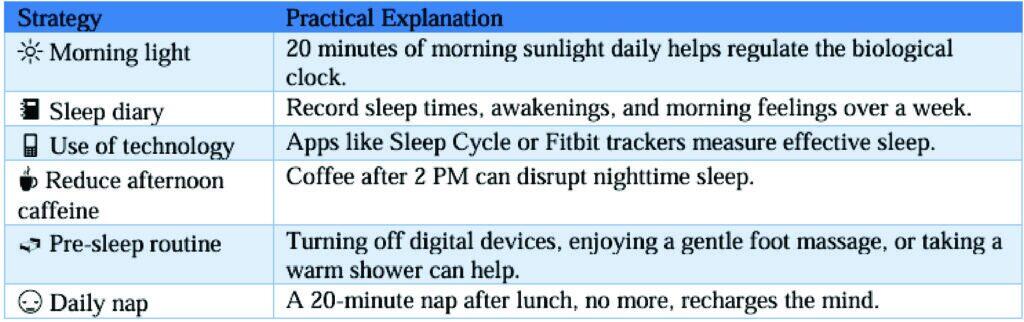
What Should Be Done? Suggestions for Caregivers:
Conclusion: Sleep, the Protector of Older Adults’ Brains
On the path of aging, every hour of good sleep means healthier and more independent years.
Quality sleep is an inexpensive but highly effective medicine for preventing brain decline,
forgetfulness, depression, and cognitive weakness.
“Mary, our story’s character, after getting her sleep schedule on track and shortening her naps,
surprised us one day: ‘I reme
Reference:
Westbrook, S. et al. (2023). Impact of sleep duration on executive function and brain
structure. Nature Communications, 14(3).
Qiu, K. et al. (2024). Threshold effects of sleep duration and cognitive function in older
adults with BMI ≥ 25. Frontiers in Aging Neuroscience.
Sakal, C. et al. (2023). Sleep efficiency variability and cognition. arXiv preprint
arXiv:2309.08809.
Casagrande, M. et al. (2022). Sleep Quality and Aging: Healthy, MCI, AD.
International Journal of Environmental Research and Public Health, 19(14), 8457.
Xie, L. et al. (2013). Sleep drives metabolite clearance from the adult brain. Science,
342(6156), 373–377.
WHO. (2024). Sleep and Brain Health in Aging Populations. World Health Organization
Reports.
Washington Post. (2025). Naps and brain function: what new meta-analyses reveal.
In the next article, we will discuss the “Tips to Boost Brain Health at Home”.

About Rose Hill Care at Home
Rose Hill Care at Home is a licensed home care agency based in Richmond Hill, proudly serving seniors across the Greater Toronto Area. We offer personalized, professional support services to help elderly individuals live safely and comfortably at home. Our team of certified PSWs and caregivers provide assistance with daily activities, dementia care, companionship, post-surgical recovery, and more.
At Rose Hill, we are committed not only to exceptional care but also to educating our team and our audience about aging-related challenges. We believe that knowledge empowers better care—so please follow us for more helpful insights and real-life solutions related to senior health and wellness.
📍 Serving Richmond Hill, Toronto, Vaughan, Markham & surrounding areas
📞 Contact: 905-237-9898